How to check that a property's title is clean before you buy
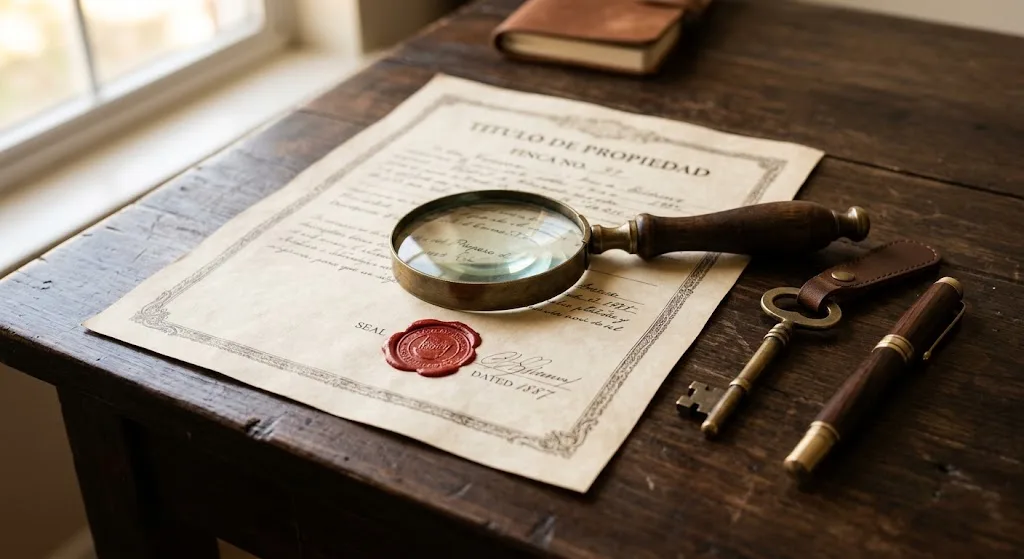
When a client asks me what matters most when buying, I do not talk about the view or the kitchen. I talk about the title. A beautiful property with a problem title can cost you years of paperwork and, in the worst case, your money.
The good news is that in the Dominican Republic the title can be checked before you pay. As a lawyer by training, it is the first thing I review with my clients. Here is how it is done.
What "clean title" means
We say a title is clean when three things are true:
- The person selling is the owner, or is legally authorized by the owner.
- The property has no encumbrances: no mortgages, liens, objections or pending lawsuits.
- What the paper says matches reality: the square meters, the boundaries and the location.
If any of the three fails, the title is not clean, even if the seller is someone you trust.
Step 1: the title certificate
Ask to see the original title certificate, not just a copy. Check:
- That it is in the seller's name, with their full details.
- That the description of the property matches what you are being sold.
- Whether it is a surveyed title, with its own cadastral designation, or a constancia anotada, which is a portion of a larger parcel with no individual survey.
A constancia anotada can be bought, but it carries more risk and many banks will not finance it. If you will use a loan, confirm this before making an offer. In the article on how a mortgage works I explain why the bank reviews the title.
Step 2: the certificate of legal status
This is the key document. It is issued by the Title Registry, the system governed by Law 108-05 on Real Estate Registration, and it shows the property's legal situation at that moment:
- Who the registered owner is.
- Whether there are registered mortgages and in whose favor.
- Whether there are liens, objections or precautionary notes.
- Whether there is a litis, that is, a court case over the property.
Do not settle for a certificate handed to you by the seller. Your lawyer should request it directly.
If a mortgage appears, it is not always a problem: it can be paid off with the sale proceeds at closing. But how and when it will be cancelled must be put in writing.
Step 3: who can sign
The owner appearing on the title is not enough. You need to confirm they can sell on their own:
- If they are married and bought it during the marriage, their spouse usually has to sign too.
- If it is an inheritance, the heirs must be recognized and the property in their names before selling.
- If a company owns it, there must be a resolution authorizing the sale and naming who signs.
- If an agent signs, the power of attorney must be specific and still valid.
Step 4: debts that do not show on the title
Some debts do not appear on the certificate, but they can pass to the new owner or make life harder:
- The property tax (IPI). Ask for the DGII certificate confirming it is up to date.
- Condominium maintenance. Ask for the management's no-debt letter.
- Utilities. Check the latest electricity and water bills.
Step 5: see the property with the plan in hand
The paperwork can be perfect and reality something else. Compare the plan with what you see: the square meters, the boundaries and the buildings. Ask whether anyone lives there and on what basis, because a tenant or an occupant can delay the handover. For land, it may be worth having a surveyor confirm the boundaries.
Warning signs
Stop and look more closely if:
- The seller only has copies of the title or makes excuses not to show the original.
- You are pushed to pay before your lawyer finishes the review.
- The price is far below the market with no clear reason.
- You are asked to deposit into the personal account of someone who is not the owner.
Unfortunately, forged titles exist, as do cases where the same property is sold to two people. Checking directly with the Title Registry is your best protection.
And right before signing
Weeks go by between the promise of sale and closing. Ask for a new certificate of legal status right before signing, to confirm nothing has appeared in the meantime.
If you are selling rather than buying, the article on documents to sell your property tells you what to prepare. And in the buyer's guide you will find the whole process. If you have a property in mind, I will gladly review its title with you before you hand over a single peso.
Comments
-
mpm ·
dsadsa
Reply to mpm
Monthly newsletter
Once a month: new properties, market news and tips for buying, selling or renting. You can unsubscribe at any time.